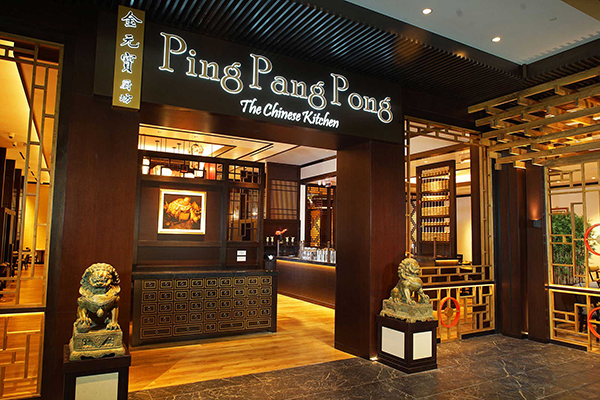
In 1973, Andrew Cherng opened the first Panda Inn restaurant, in Pasadena, Calif. Since then, Cherng and his team have grown that singular location into Panda Restaurant Group, which owns more than two thousand restaurants across the United States, primarily under the Panda Express banner.
During all that growth, the original Panda Inn location kept operating in the same spot in Pasadena, year after year, decade after decade. In 2022, nearly fifty years after it first opened, Cherng decided to revitalize the original location. The result is a new Panda Inn flagship restaurant, which opened its doors in early 2025.
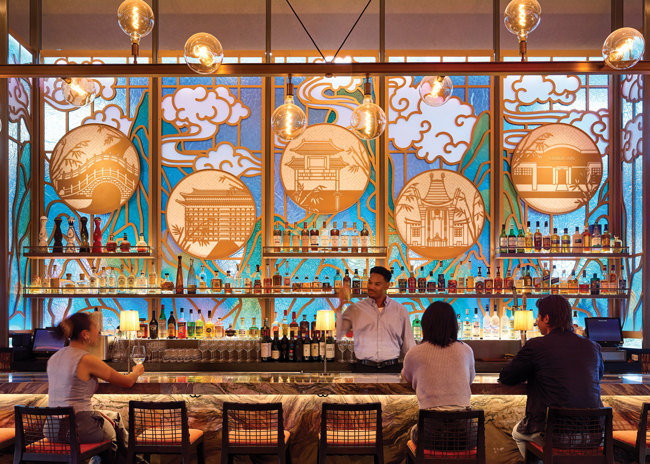 This stained-glass style installation is actually made of resin. The medallions symbolize the founder’s journey from China to Pasadena, with stops in between. Images courtesy of Panda Inn
Arcadis, a global engineering and design firm, handled the operation’s architecture and interior design. Yuwen Peng, an associate principal at Arcadis, led the effort.
According to Peng, this Panda Inn location holds a special place in the heart of its founder. Not only was it Cherng’s first restaurant, but it also became a fixture in the community, a place where neighbors come together and families celebrate special occasions.
The design team, then, was charged with honoring and continuing Panda Inn’s history and role in the community, while also helping guide the brand into the future.
“They wanted to use it as an incubator for their new ideas…[for] innovations in the restaurant industry and how they serve the customer.
We were being asked to find what the new Panda Inn is going to be while also upholding the significance of the first location as well as the 50-year special occasion,” Peng says.
That’s a lot for one project to achieve. So instead of putting pencil to paper right away, the designers started with research and collaboration. This part of the project, Peng notes, accounted for a big chunk of the job’s three-year timeline.
The design work largely began with collaboration among the design team, the Panda Inn culinary team and company leadership.
These groups formed a “golden triangle,” where each would push and pull the others to develop the flagship’s concept. Their work included not just design decisions but possible menus and how the restaurant could be built in response to those menus.
Notably, then, the design work included not just the dining area but concepts for the back of the house, too, such as how to showcase the most dramatic elements of Asian cooking.
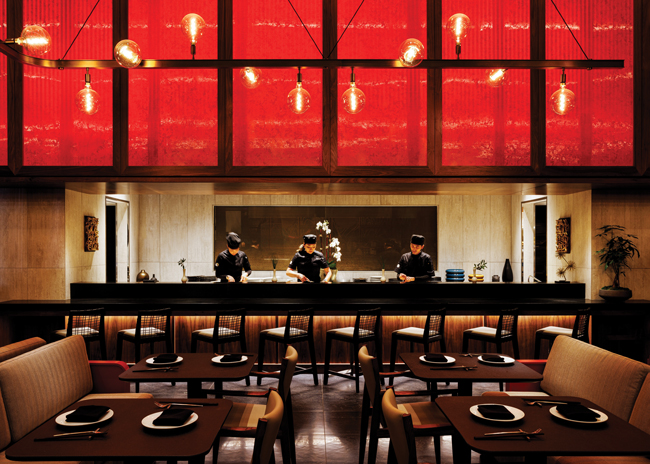 Panda Inn’s sushi bar is kept intentionally minimal to allow for future menu tests and changes.
The different ideas were then sent into testing. Dishes that represented menu concepts were offered at other Panda Inn locations, while focus groups of customers and community members gave feedback on food and even design concepts.
These steps, Peng says, helped Panda Inn expand its appeal while maintaining its strong connections to the community.
“People have their own story growing up with Panda Inn, going there for a big feast of Chinese American food. They want to keep the birthday parties, the graduations, the family gatherings. However, they also don’t want to keep it [only] that way. They want to attract younger customers. So that was our task, to keep our existing customers but expand the menu and customer experience to [attract] young professionals. The existing community is moving toward that from single families to more condos and high-rises. So, we’re growing with the community.”
After multiple rounds of testing, the team developed the concept for this flagship Panda Inn. The restaurant’s menu would feature smaller, shareable plates, sushi and cocktails such as the Lychee Martini and Ginger & Ginseng Mule.
And of course, they also developed a design concept that would highlight these offerings.
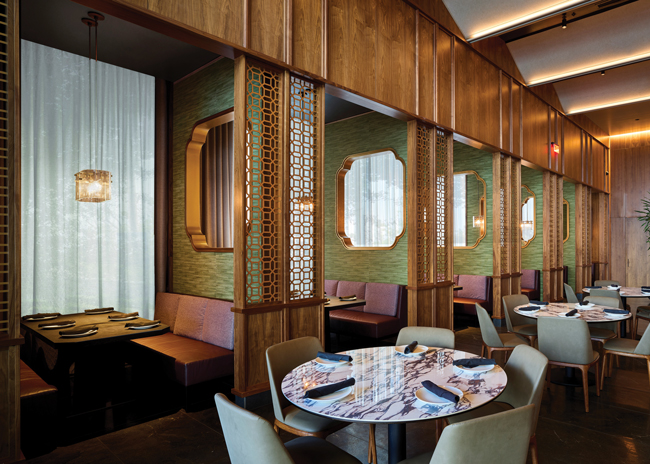 Semi-private booths encourage celebratory gatherings. The curtains allow guests to separate themselves from the busy street outside.
A Restaurant and an Inn
Construction on the flagship began in 2023. While it’s located on the site of the original Panda Inn, it’s not in the same structure. The old building would have presented construction challenges, and it simply wasn’t big enough to achieve what the company wanted to do. The new structure is 50% larger than the previous one.
The new building does have some elements of the original Panda Inn, though. The designers were able to keep one exterior wall, for instance. In addition, a sign above the entryway doors spells out Panda Inn in traditional Chinese characters just like the ones used on the original location, notes Peng.
Key design statements start on the exterior of the restaurant. Large, covered patios sit on each side of the walkway to the main entry. These are as an appealing, welcoming feature for guests, Peng says, but they also allow the restaurant to host roughly 800 Panda Restaurant Group employees who regularly come for training.
Dry gardens — landscaping that doesn’t require irrigation thanks to drought-resistant plants — wrap around both patios. These are reminiscent of Cherng’s birthplace in Southern China, but they also serve a practical purpose. “When you sit at the outdoor patio, surrounding it with this landscape filters a little bit of the heavy traffic,” says Peng.
The patios not only offer an outdoor seating option, but they also help create an exterior look reminiscent of an actual inn — the restaurant is Panda Inn, after all. This appearance is achieved with the Panda Inn sign at the front of a long, covered walkway into the building. Guests are greeted with double doors, each with a stylized door pull that together forms a circle. The circle, notes Peng, represents the moon, which is a symbol of community in many Asian cultures; it is a shape found throughout the restaurant’s design.
The restaurant’s inn theme hits even harder when guests walk through the doors. Instead of a simple podium for a host stand, this flagship has a long desk.
Immediately behind the host stand is a large stained glass-style mural, one of the centerpieces of the restaurant’s design. This piece features clouds and flowing shapes along with five circular medallions. The medallions, says Peng, represent the Cherng’s immigrant journey, starting with China, then to Taiwan, Japan, the United States, Hollywood, Calif., and, finally, Pasadena.
The piece also pays homage to the Pasadena area’s 125-plus-year history of stained-glass artisans and studios, Peng notes.
Instead of being made of stained glass, however, this installation was created with resin panels and lit with LEDs. It’s also two-sided, allowing it to serve as a focal point for the space that best reflects the flagship’s interplay of menu and design: the bar/lounge.
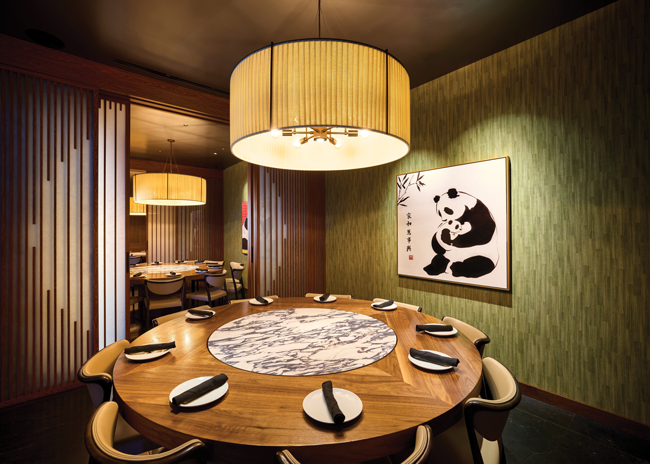 The private dining rooms at Panda Inn’s flagship feature wallpaper reminiscent of Chinese greenery, while the circular pattern on sliding doors evokes the moon, a symbol of gatherings in many Asian cultures.
One Space, Two Bars
The lounge area is anchored by two different bars: one for cocktails and one for sushi, with lounge-style seating in between.
The cocktail bar features the stained glass-style mural with the immigrant’s journey medallions. In front of this feature are shelves holding liquor bottles. Like the mural, these are lit with LEDs.
The bar itself also highlights the idea of a journey, though in a less direct way. The bar top and bar face are made with a natural stone with long flowing veins, giving it a very organic, natural feel, Peng says.
The stools at the bar, like all furnishings, are custom made and feature upholstery in the brand’s signature red color.
On the opposite side of the lounge is the sushi bar. This area features stone tile on the walls while above it is glass lit in the signature red.
From the customer perspective, though, the highlight of the sushi bar is what’s behind it: a glass window giving them a full view of the production kitchen. This area is laid out for maximum theatrics. A walkway runs down the center of the space and there are six wok stations. Customers at the sushi bar end up with a view of active chefs and even flame from the woks.
In addition to creating drama, the sushi bar connected to a display kitchen will allow for future menu experiments, notes Peng.
“We intentionally designed the sushi bar to be very minimal in case they want to have a new testing menu in the future. Behind this is the exhibit kitchen, so if they really need firepower, it’s right behind them, so [the kitchen] can support this testing menu,” says Peng.
The sushi bar was also designed to support operations throughout the restaurant. A server station/expo area sits to the right of the bar, behind a door. To establish a smooth flow of traffic, staffers enter from the left, walk to the right, then enter the server station where they refill drinks and dip fortune cookies in white chocolate for the chain’s signature end-of-meal treat.
Lounge space between the sushi and cocktail bars features soft seating and traditional chairs. “We created a little bit more of a hotel lobby environment with the low seatings, small tables and cocktail tables. That created the intimacy at the heart of the restaurant,” says Peng.
The lounge features a large lighting fixture overhead with large clear globe bulbs. These offer a “starlight” feel, Peng notes, while simultaneously making the space more intimate. Lightweight, fabric acoustical panels were hung above. These can be easily removed in case maintenance is needed for the lighting, electrical, speakers or ductwork that runs on the ceiling.
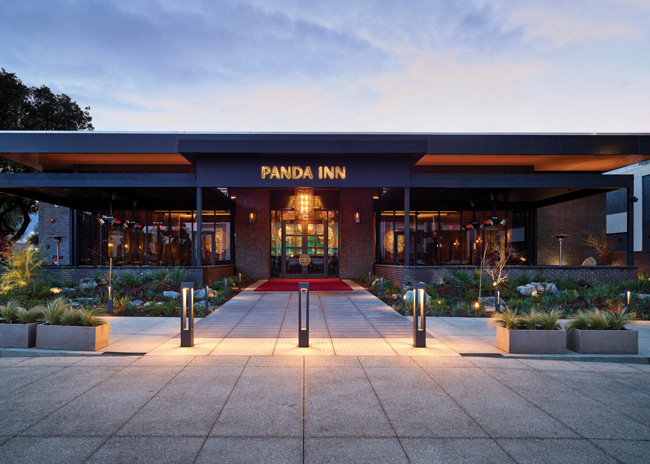 The new structure was given two large patios and an entryway reminiscent of a hotel.
Beyond the Bar
While the bar/lounge area sits in the center of the new flagship, the more traditional Panda Inn dining experience is offered on the restaurant’s perimeter, Peng says.
This space includes semi-private booths with dividers that run floor to ceiling. The windows at the booths look out onto a busy street, so there are curtains guests can open or close, depending on their desired dining experience.
The main dining area also features large round tables for groups. These tables are made with walnut and have built-in lazy Susans fashioned with stone — another example of the moon theme. Like the bar material, this stone has natural veins. In this case the veins are black on a white background. “Panda Inn’s dishes are super colorful, so it acts as a background for the plates,” Peng says.
With an emphasis on gathering and community found throughout the restaurant’s design, it’s only natural that the main dining area also includes three private dining spaces. Each feature one large round table with a built-in lazy susan. They’re separated from each other with sliding doors that, when closed, reveal a stylized moon design, once again emphasizing the connection the restaurant is designed to foster.
With the flagship Panda Inn open a year, these sorts of connections are one of the best things about the restaurant, says Peng. A resident of the area herself, these gatherings are something she has experienced and values. They show what restaurants can be for a neighborhood.
“I was dining there, and it’s very easy to strike up a conversation. I learned so much about the neighborhood just sitting right there. Especially after the [Los Angeles area] wildfires, everyone was able to come out again and say ‘Hey, there’s a resource here,’ and ask each other about rebuilding. It’s humbling and meaningful. It’s what a restaurant could be, this social space to be with the community, and to connect people, and to have a joyful meal.”
Project Team
- Architect and interior design: Arcadis, Los Angeles
- Interiors concept: Syuan Fu Yu, OCT & Associates, Taiwan
- Lighting: Oculus Light Studio, Culver City, Calif.
- Kitchen: Clay Enterprises, Santa Ana, Calif.
- MEP: Walsh Engineers, San Diego
- Landscape: Korn Randolph, Pasadena, Calif.
- Graphics: Kith & Kin, Hong Kong
Snapshot
- Owner: Panda Restaurant Group, Rosemead, Calif.
- Concept description: Full-service restaurant with a cocktail and sushi bar; traditional seating on the restaurant’s perimeter and private dining rooms accommodate large gatherings; interior design celebrates the restaurant’s 50 years at this location
- Unit count: Four locations, all in California
- Size: 10,527 square feet on the interior; 1,130 square feet in exterior patio space
- Real estate: Free standing
- Design highlights: Bar/lounge area with two bars, inn-style host stand; stained glass-style mural celebrating the immigration journey of the brand’s founder; large round tables with built in lazy susans made of black and white stone; two large patios surrounded by dry gardens that help separate guests from street traffic.
- Build-out time: 24 months