COVID-19 brought big changes to the way Americans eat. Pickup and delivery became the norm for diners during the pandemic, and these methods of procuring food from restaurants have remained popular.
Restaurants offering food to-go have many iterations. Some are drive-thru only; some are more of a kiosk. Others, like Döner Haus, are simply a takeout window.
Döner Haus opened its first storefront in the East Village in 2023 and has since added three more locations in New York. Business is almost exclusively takeout. Two of the locations have no seats, and the other two have some sparse outside seating. Customers order from an employee or through a screen outside the locations. Between 35% and 50% of orders are digital, and more than half of orders are for delivery.
At quiet times, Döner Haus can operate with a single employee; at peak periods, it needs three people: two cooks and a front-of-house/expo person.
“Everyone told us this was a bad idea,” says founder and CEO Nik von Solodkoff, “but we hit $2 million in sales in the first year, so that indicated that this concept, despite being different than what Americans are used to, can work.”
The design of Döner Haus was inspired by Germany’s popular döner kebab shops, which are window-only concepts. Von Solodkoff wanted to bring these kebabs to Manhattan, where rent is high, square footage is minimal and speed is of the essence.
Onigiri concept Onigilly operates primarily out of malls. There are seven locations in Southern California, only two of which have seats, around 20 each. The others operate as kiosks out of 300 square feet in the main area of malls — not food courts in order to avoid higher rent, required seating fees and direct competitors, says owner and CEO Koji Kanematsu. The kiosks require two to three people to run — up to five during peak periods — and generate $1.8 to $1.9 million per year.
All but one location are corporate stores, but future locations will be franchised. Next year, Kanematsu will open at least five locations. “Our goal is to have 200 to 300 locations in the next five years and to eventually become nationwide,” he says.
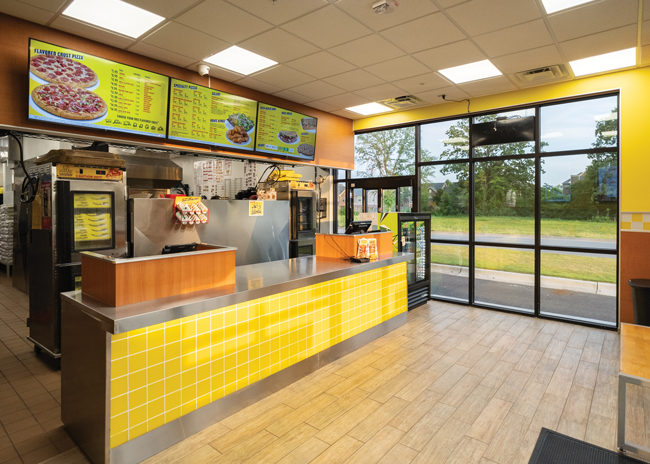 If it can, Hungry Howie’s likes to have separate designated pickup spots for delivery drivers. Image courtesy of Hungry Howie's
Back-of-House Considerations
Creating a takeout-only restaurant requires considerations of practicality as well as design.
“Everything is devised to be efficient,” says von Solodkoff. Items are laid out in a single line; some vegetables arrive chopped. “We do one thing, and we do it right. The more stations you have, the more recipes you have, you make things complicated, slower and prone to error.”
To operate in small mall footprints, Onigilly changed how it operates. Formerly, the brand cooked food in a central production kitchen, but now it all comes cooked directly from manufacturers in Los Angeles and Japan. “They cook to our recipes,” says Kanematsu. This will also make it much easier for the brand to expand into franchising.
Rice is cooked fresh in a rice cooker and then shaped into triangle patties by a robotic machine to keep labor down. Filling is added, and the whole thing is wrapped in seaweed.
The back of house of pizza chain Hungry Howie’s, Madison Heights, Mich., is also designed for efficiency. A U-shaped line, which saves space, follows the pizza process from crust to toppings.
Consistency is “nonnegotiable” for Marco’s Pizza, Toledo, Ohio, which has more than 1,200 locations. These kitchens are also designed in a U-shape “to control process flow and ensure smooth handoffs from prep to makeline to oven to pickup,” says Gerardo Flores, chief development officer.
Designated Pickup
Takeout-only restaurants have three types of customers: those who order in the store and wait for their food, those who order digitally and pick up their meal, and those who order online for third-party delivery. It’s important to make it easy — and pleasant — for each of these groups.
Hungry Howie’s store lobbies depend on size. In larger stores, there’s a separate section for third-party pickups. “In stores where we do not have the extra space, we utilize the existing front counter with signage for third-party pickups,” says Steve Clough, vice president of franchise development. “We keep it at the opposite end of the counter than the order station, so it’s easy to identify drivers.” The brand emphasizes third-party delivery drivers’ comfort because “typically, they don’t like to come into the store. It’s a core piece of how we recognize who’s coming in.”
Pizzas ready to be picked up are kept in hot holding cabinets that can be accessed from the kitchen and the front counter.
Marco’s Pizza also has guests who prefer not to come into the store, so the chain has designated parking spots for curbside pickup. These have very clear signage, and inside the restaurants, pickup counters are “highly visible and intuitive,” Flores says. This means, he explains, that the design puts convenience front and center. “When a guest walks through the door, they’re immediately oriented; the counter is the focal point. We want customers and delivery drivers to know exactly where to go without hesitation.” The layout is uncluttered, he says. “It’s about eliminating friction for every type of guest interaction.”
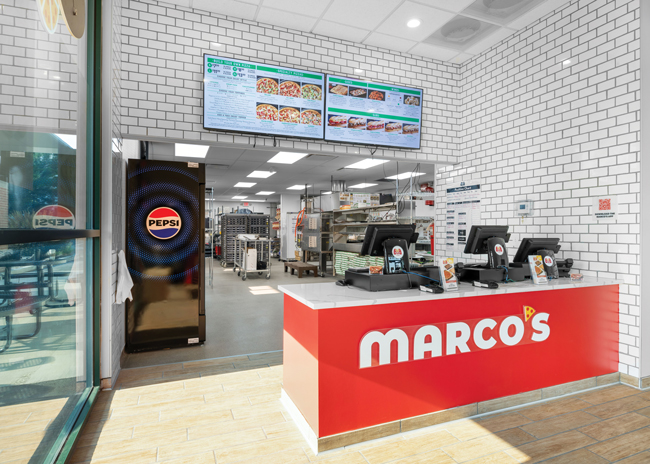 Marco's Pizza has leaned heavily into pickup windows to make it easier for patrons to grab and go. Image courtesy of Marco's Pizza
Winning with Windows
Pickup windows can also help reduce friction for guests and delivery drivers. These “can add a huge benefit from a sales perspective,” Clough says. “It’s a nice-to-have, and it’s a significant uptick in sales if we have it.” This window needs good signage and branding, he says, and often has a dedicated employee at busy times. Hungry Howie’s also includes signage throughout the parking lot so guests know they can use the window.
Limited-service restaurants can make a big impact with a pickup window; there are still several touchpoints to create a connection with the customer, says Rachel Edmonds, associate strategy director at FutureBrand in Amsterdam, which works with many U.S. restaurant concepts. “What does the facade look like; what does that small window look like? What’s surrounding it? What’s the hand-over moment? These small things add up to a whole. Those cues are still important even if you’ve literally got such a small window of time at the window.”
Marco’s Pizza has leaned heavily into pickup windows. Customers place their order, “then simply pull up and grab their meal,” says Flores. The chain has invested in tablet technology that functions separately from the in-store POS, so pickups don’t slow down inside business.
Emotional Connection
An important aspect of takeout-only restaurants is that they still create an experience for the guest, however brief. The chance to make a positive impression is condensed but as important as ever.
“Every space, even if it has only a few moments of connection, can still be distinctive,” says Edmonds. Restaurant concepts should create a strong brand personality with their interiors, she says, and take into account textures, colors and lighting. “It’s really about, how do we translate the brand DNA into spatial DNA? So that impression, even if you’re only there for two or three minutes, is distinctive.” She adds, “It’s not about slapping your logo and your brand color everywhere,” but instead about thinking of customers’ five senses.
Hungry Howie’s puts a lot of attention on customer service. “We have a unique opportunity when handing someone a pizza to smile and say thank you, and that’s an opportunity we should take advantage of every time,” says Clough. “We can also show them the pizza to make sure we’ve got it right. It takes effort and commitment.”
Marco’s Pizza defines hospitality by how customers “feel during every interaction with our brand,” says Flores. “We train our teams to bring that human element into every channel — counter, curbside, window or delivery handoff. Hospitality lives in the details, and when executed well, it builds trust and loyalty that keeps guests coming back.”
The chain also tries to make every encounter guests have with the brand as easy and intuitive as possible. It uses signage, digital prompts and strategic layout choices to guide guests to the right place. “From the moment a guest arrives, they should feel like the restaurant was designed with their convenience in mind — because it was,” says Flores. “Even during peak times, the goal is for guests to sense order and efficiency, which ultimately reinforces the superior quality and reliability our brand is known for.”
Sharing a Kitchen
This fall, Chef Eric Adjepong opened Dawa, a carryout and delivery concept operating from his fine-dining Washington, D.C., restaurant Elmina. Guests pick up their food from the host stand, and a staff member takes food outside to delivery drivers.
Both operations have similar menus with bold Ghanian flavors, but Dawa has a more casual vibe. It’s open for lunch and dinner and offers carryout and pickup. “It’s exciting to have multilayered hospitality with West African food,” says Adjepong. “Dawa provides an affordable quick-service option and gives us a place at that table.” It is an opportunity to introduce potential customers to West African cuisine at a lower price point.
Adjepong’s goal was to boost the kitchen’s efficiency since Elmina’s dining room is closed at lunchtime. “Dawa is a great opportunity to get some reps in with the kitchen staff and also proof of concept to see if Dawa has legs to do this elsewhere,” he says.
Adjepong hired a couple of new employees to help with the new concept, but it hasn’t required a big labor investment, he says. What was more important was that there was a lot of ingredient crossover, so the small kitchen didn’t need a lot more storage space for Dawa. Adjepong has added a couple of warmers and an additional flattop and grill — much less than if he’d opened the concept from scratch — and all of these can be used for Elmira as well.
Drive-Thru Elevation
Last year, Chick-fil-A opened its first elevated drive-thru restaurant. This drive-thru-only Atlanta restaurant has a unique meal transport system. A conveyor belt transports the meal from the kitchen above to the service area below. It’s capable of delivering a meal every six seconds.
The goal of the design of the restaurant, which is still in the evaluation phase, was to increase speed of service and simplify the drive-thru experience. The kitchen is twice the size of Chick-fil-A’s other drive-thrus “to boost capacity for food preparation,” says Jonathan Reed, executive director of design for the chain.
The drive-thru has four lanes and can serve two to three times more vehicles than a standard Chick-fil-A restaurant drive-thru — up to 75 cars at once, Reed says. Guests can order ahead on the app or place an order at the drive-thru. Two lanes are dedicated to traditional orders, and two are for digital orders. If guests have questions, they can utilize designated pull-aside lanes to chat with employees.