
In 2023, an almost fully automated burger joint, CaliExpress by Flippy, opened in Pasadena, Calif. The outlet is a living laboratory for Miso Robotics’ robots and AI. The restaurant does employ humans who add final touches and serve orders to guests, but robots do all the cooking. It’s an attractive business model, with robots preparing orders consistently and rapidly, allowing the business to operate with fewer workers.
With a tight labor market and minimum wage rising in some states, new technology can be a game-changer for food and beverage brands, particularly in the QSR space. Technology like AI-powered drive-thru ordering systems, in-store kiosks, and mobile apps for tableside ordering, in addition to robotic cooking equipment, can be used to make a brand more automated. But these technologies do come with challenges.
Their adoption presents questions for interior and exterior designs along with operations. What is the appropriate amount of automation for the business model? How do designers accommodate the technology in the brick-and-mortar realm?
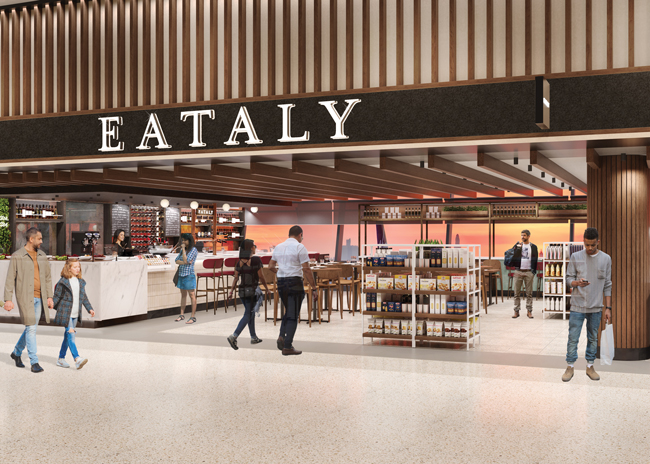 Mobile apps allow guests in a busy airport environment to place orders and track their status. Image courtesy of Ideation Design Group.
“Often, the best tech is when you don’t even notice that it’s there,” says Siobhan Barry, principal and design director for design firm Gensler. On the other hand, she says, some brands have recently been showcasing technology. “It’s a big shift. Technology used to be more invisible, but now it’s more celebrated.” Sweetgreen, for instance, is opening some “almost human-less locations.” Salad-shooter robots that assemble orders look great, and guests watching the technology in action find it cool, she says.
“This speaks to what we want in quick serve,” Barry says. It’s all about speed and accuracy in the QSR world. By contrast, “in fine dining, we want human connection. So, we have robots for speed, humans for hospitality.”
One issue that will take time to sort out is to what extent automation will be adopted in the fast-casual space. As labor gets more expensive, how can businesses in between QSR and fine dining succeed, and can automation help? “Can you pay staff and run a business with the quality of the high end?” Barry muses. Large chains may be able to invest in more technology to boost efficiency, but what will happen to mom-and-pop establishments that can’t afford it?
The latest automated technologies do not require drastic alterations in restaurant design, but some do require thoughtful adjustments. Some cooking robotics, for instance, need extra space to operate. Jennifer Reynolds, principal, Ideation Design Group, points out that the design of a Wingstop at the Dallas-Fort Worth airport included a 5-foot aisle for deep-fryer robots rather than the typical 3-foot aisle. “This equipment has to move an arm from a stationary base point,” she explains. “You need extra clearance. You can’t have people bumping into it.”
Brands that have wholeheartedly adopted cooking automation are rarities.
Hot dog chain Wienerschnitzel is looking at back-of-the-house robots but is not yet ready to test the technology, says Shak Turner, director of franchise development for the brand. Wienerschnitzel will monitor developments to gauge whether potential gains in efficiency merit the investment.
MOOYAH Burgers Fries and Shakes is taking a similar stance. “The brand believes in face-to-face interaction,” says Landon Lane, senior director of construction and design for the chain. The chain, however, has adopted some non-robotic cooking equipment that speeds up service. A vertical bun toaster that toasts both sides simultaneously has helped expedite drive-thru orders. A burger “accelerator arm” achieves the same with beef patties, eliminating the need to manually flip burgers. “This cuts cooking time in half.” Despite the efficiency gains, though, the brand has not reduced back-of-the-house labor.
MOOYAH sites are using the faster, pricier cooking equipment for drive-thru service only. “We are trying to keep costs down on corporate-owned sites,” Lane says. Another line is focused on traditional in-store orders.
“Drive-thru is more urgent. Franchisees do have the option to purchase more accelerator arms if they want to.” As for supporting this speedier equipment in the field, Lane needs only to add an additional electrical circuit to an existing unit. “It’s just a couple of hundred dollars to do that,” he says.
Wienerschnitzel has taken the plunge into AI voice-activated ordering on the drive-thru line. “We started testing it in 2023,” Turner says. “It was a little clunky at first, but as time has gone on, it has advanced extremely.
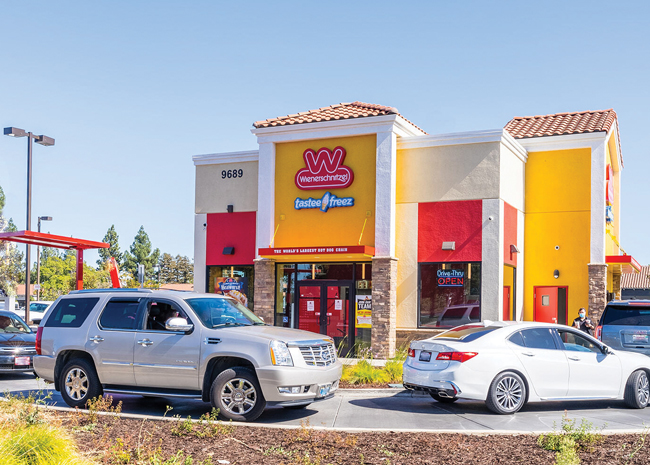 Wienerschnitzel sites include an exit door near the takeout window so that staff can bring some orders to guests. This makes the drive-thru lane operate more efficiently. Image courtesy of Wienerschnitzel
There is now greater accuracy.” The technology takes orders through a voice-activated kiosk. Orders are instantly conveyed to the kitchen, allowing staff to prep orders faster.
The brand has seen another notable benefit: an improved upselling rate. “AI upsells to every guest,” Turner says. “When employees are busy, they might not always upsell.” The AI is programmed to link certain items for upselling to certain types of orders.
Customers are informed at the outset that they are speaking with AI.
Employees in the store monitor AI/guest interactions on their headsets and can override the AI when it glitches. Order accuracy has improved to about 90% with AI, Turner says, so staff are stepping in less and less. “AI is learning faster with each day,” she says. It did get hung up on slang and regional-specific terms (“y’all,” for instance) at first, but many of those wrinkles have been ironed out.
The technology is currently English only, but it could be programmed to use Spanish. “The problem is that many Spanish speakers mix in English words, and that can confuse AI,” Turner says. “If Spanish-speaking AI is adopted, it could translate Spanish to English in POS and kitchen displays.” The chain trained AI at a group of 20 to 30 stores. “We are up to 90 stores now and will have all 300 brick-and-mortar locations using it next year.”
Customer and employee feedback has been positive, Turner notes, and the technology has not resulted in reduced labor. “People assume AI is going to replace humans,” she says, but rather, the technology aims to reduce operational complexities and to upsell, allowing people to do their jobs better. “Instead of doing five things, maybe they are doing four better and with less stress.”
MOOYAH has moved to a new drive-thru tracking system that has saved money and improved service. The system, which uses cameras to link orders to cars allowing employees to monitor wait times, replaces one that kept tabs on the drive-thru queue via a loop detector embedded in the pavement. This required contractors to cut into the pavement. The new camera-based system doesn’t require any special construction work, saving about $6,000 in costs, Lane says. Employees can now note if a car has been waiting for an excessive period and bring the order out to them if so. The new system has been a success. “We’ve tested it and retrofitted a couple of locations,” he adds.
Another technology, QR codes that prompt menus on smartphones, gained traction during COVID. That trend subsided after the pandemic ended, but some brands still use it. The technology has limited appeal, Reynolds notes, as some guests find menus on the small screen inadequate.
“Formatting is an issue on handheld devices,” she says. “Not everybody loves it.”
Reynolds notes that Texas Roadhouse is using technology adapted from QSRs to boost service efficiency. The brand enables both ordering and paying via a linked app. Upon arrival, guests can place a drink order, and a server will bring it to the table at first contact. This saves time and allows servers to cover more tables. By bolstering features a bit, this technology could aid fast-casual brands to compete with QSR brands for value-conscious customers, Reynolds says. If guests can reserve tables and place orders via mobile before they arrive, they could experience near QSR-level speed along with personalized service from waitstaff.
Mobile apps for tableside service are catching on quickly in nontraditional settings. “Bring-it-to-you-concepts work well managing stressful situations like airports,” Barry says. In fact, mobile apps are essential for this business model.
In-store ordering kiosks are becoming common in the QSR realm, and brands are sorting out where to best place them and how many are appropriate for each location. “In-store kiosks have changed how we design the restaurant today, and designs will continue to change,” Turner says.
The same is true for MOOYAH. “It’s a standard piece of our technology package,” Lane says of the kiosks. “Typically, we do two; a few locations have one due to space constraints.” Kiosk location varies based on store layout, but a common arrangement is one near the queue line and another on the POS counter. The latter location makes it easy for employees to assist guests with the technology.
Construction requirements for kiosks are modest. A few MOOYAH locations have extended their counters 2 or 3 feet at most, Lane says. Positioning a kiosk at the counter next to traditional POS units is less costly than posting one on the floor, he points out. “You already have all the power and data there, so you don’t have to extend it out,” he says.
All this technology points toward a more automated restaurant industry. An Aaron Allen & Associates forecast suggests that as much as 82% of restaurant roles could potentially be replaced by robots, with 31% of those roles devoted to food preparation. If and when this will happen is conjecture at this point, though.
Reynolds notes that with liberal adoption of automated technology, brands could maintain their quality of offerings and service in smaller units using less labor. But, she says, people in the restaurant business love the hospitality of the industry, which means operators may be resistant to such sweeping changes. Time will tell how it all shakes out and how designs specifically will be impacted.


